Thursday, 16 August 2018

Bell 206B Jet Ranger Helicopter G-ODIL

Helicopter Crash Site William Clough Kinder Scout


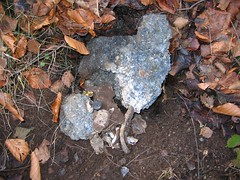
Contrary to the assurances Pat received in the past from anoraks, there is in fact still authentic helicopter wreckage in William Clough. It wasn't even that hard to find.

Location: SK 06655 89697

Bell 206B Jet Ranger Helicopter G-ODIL

Bell 206B Jet Ranger Helicopter G-ODIL in William Clough, Kinder Scout


Yorkshire Helicopters 24 October 1997
Pilot: uninjured (and anonymous)

Newspapers, both local and national, asked not to divulge the pilot’s identity, chose to honour the request; neither is it Air Accident Investigation Branch policy to publish names. Helicopters have been widely employed in conservation and restoration work in the Peak District, one of their major tasks being to airlift stone slabs from redundant mills to be laid as paving in the style of the medieval ‘causey paths’ over the most boot-eroded sections of the area’s peaty tracks. Among other tasks have been the airlifting of fencing materials; of heather tops from lower moors for reseeding denuded moorland; and of water for fighting fires.

Hiring helicopters, although expensive, has proved to make economic sense, one of the many advantages being that the moors do not suffer the damage caused by surface vehicles. Indeed the ground was barely marked when Jet Ranger G-ODIL suffered a dynamic-rollover upset – effectively, tipping itself over – in the course of lifting stone from the shoulder of Ashop Head, at the summit of Kinder’s William Clough.

A first load, at an estimated weight of one thousand pounds, had been successfully lifted. However, the steep and restricted nature of the 1,750-feet-above-sea-level site had made it difficult to turn into wind, so that, without the assistance of the full wind speed, the helicopter had required its maximum torque to lift off, and then move forwards from the hover. Notwithstanding this, the second load proffered was even heavier; only then the pilot was quite unable to accomplish the transition to forward flight. He tried to set the load down again, but as a skid made contact with the ground a rolling motion was imparted and the helicopter, with its ability to respond to corrective lateral control now diminished, tipped onto its side.

The pilot was unhurt, but the machine sustained extensive damage and was eventually airlifted to the A57 at Doctor’s Gate. Although the aircraft was severely damaged it was not that badly fragmented and in 2006 Pat reported that nothing remained, certainly on the surface of the site, the few scraps of debris left behind after the clear-up operation having been taken to the Hayfield Ranger’s station near Bowden Bridge, where they were still to be seen.

North American F. Mk.4 Sabres (or are they Canadair CL-13s?) XD707 and XD730 :


Pat Cunningham (in the pic) offers the following information about the crash of two Sabres from No.66 Squadron, RAF Linton-on-Ouse, No. 12 Group, Fighter Command onto Kinder Scout and Black Ashop Moor on 22 July 1954 in which the formating pilots (Flying Officer James D. Horne, section leader (XD707) and Flight Lieutenant Alan Green, formating pilot (XD730)) were both killed.
When Russian-built swept-wing MiG-15 jet fighters were encountered in Korea in 1950, British manufacturers had nothing to match them. British transonic swept-wing fighters were under development to replace the straight-winged subsonic Meteors and Vampires, but until the Hunter arrived in 1955, Canadian-built Sabres filled the void. Held to be pleasant to fly, most of the Sabres were based in Germany, but No.66 Squadron was among those units equipped with them in Britain.

So it was that on 22 July 1954, four of the No.66 Squadron Sabres were recovering to Linton-on-Ouse, near York, after a high-level interception sortie flown in the course of a major annual-evaluation war-game. For the descent, the formation leader had split his section into pairs, each pair entering cloud independently at 12,000 feet.

Some time later, as his pair passed 5,000 feet, still in cloud, the overall leader transmitted an advisory warning to Flying Officer James Horne, now leading the second pair, against descending below 3,000 feet on their present heading: the more realistic safety height of the future was to be 3,800 feet. The foursome had noted already that Flying Officer Horne’s radio was weak at times, so he may not have heard the warning; certainly, he did not acknowledge.

Indeed nothing more was heard of him, or of his number two, until three days later when a walker came upon a body on The Edge, high above Black Ashop Moor. Until this discovery bad weather had hampered the search, although the keeper of the Kinder Reservoir had reported being alarmed by two jet fighters roaring at very low level towards cloud-covered Kinder. Despite his concern, however, he had heard no subsequent impact.

These aircraft had undoubtedly been the two Sabres, although what made Flying Officer Horne take his number two that low will never be known. A likely scenario, however, is that he saw a clearance below him, and dropped into what turned out to be a ‘sucker’s gap’ – a beckoning clearance which then closed in around him. Certainly, in his evidently hasty pull for a safe height, he managed to clear the edge of Kinder, but equally evidently something untoward happened after he had done so, for both aircraft struck the ground in a single impact point not many yards into the plateau.

To conjecture further, although Flight Lieutenant Alan Green, the number two, was more experienced than his leader, he was still settling in having been posted from another squadron. It could be then, that, caught out by the hastily initiated transition from level flight to very steep climb, he had – understandably – twitched just that little bit, causing his wingtip to lock with his leader’s tail. Or what is equally likely, bearing in mind that both aircraft were in very steep climbing attitudes, is that, in reaction to his leader’s over-hasty pull, Flight Lieutenant Green had pulled even harder, got high, and being momentarily unsighted from his leader, had collided in blindly pushing back into position.

The court of inquiry, however, did not treat with such speculation, finding only that Flying Officer Horne, as section leader, had failed to observe the area safety height – which he should have been familiar with regardless of any missed transmission – although it found some little mitigation in his faulty radio. It specifically noted that no blame was to be attached to Flight Lieutenant Green, whose sole responsibility had been to formate upon his leader.

Locations

SK 06926 89664 Kinder: initial impact point, start of debris trail (illustrated above)
SK 07268 90236 Black Ashop Moor: wings, gear, with an engine in an adjacent grough
SK 07300 90100 Black Ashop Moor, two debris pools
SK 07548 90390 Black Ashop Moor, the second engine

I note that there is a lot less here then in my last pic. Theft and vandalism by sad anoraks as usual.

The North American F-86 Sabre and its Canadair version, the CL 13

Pat Cunningham has offered a bit of a blurb about the Sabre, and its Canadair development the CL-13:

In the early 1950s the British-designed replacements for the by-then outclassed Meteor and Vampire fighters were suffering many developmental problems, so the appearance early in the Korean War (1950-53) of the Soviet MiGs quite discomfited the Royal Air Force planners. Accordingly, in fulfilment of a mutual defence agreement, Canada made over to the RAF 431 Sabre jets.

Fortuitously, the RAF was not a total stranger to the swept-wing type, a few of its pilots having flown with the Americans in Korea, in the process shooting down a number of MiG-15 jets. The first of the F-86 Sabre series flew in late 1947, but the version the RAF received was a 1950s development with, significantly, in terms of performance, an all-flying tail. Powered by an Allison J47-GE-13 engine developing 5,200 pounds of static thrust, it had a maximum speed of 679 mph (590 knots) at sea level, an initial climb rate of 7,250 feet a minute, and a laden weight of 17,806 pounds.

Most pilots found the Sabre a delight to fly and many expressed disappointment when it was replaced by the Supermarine Swift and by the early marks of the Hawker Hunter. Just the same, by mid-1956 Hunters had completely replaced the RAF’s Sabres, both in Germany and in the UK.

Tuesday, 14 August 2018

Short Stirling Mk.III LK502


Stirling:Lake Rudyard
Originally uploaded by seansonofbig2

Previously molten chunks of aluminium, scraps, and a marked negative terminal at the impact site of the Stirling bomber which crashed near Rudyard Lake. There are also many scraps around this location, and an adjacent patch of bare earth riddled with minutiae. Hard to believe it hasn't been kept bare by generations of souvenir hunters scratching around for bits.

Location:SJ 93949 59825

More info

Tuesday, 7 August 2018

North American F-86 Sabre F.Mk 4s XD707 + XD730: Kinder Scout Crash Site Vandalism

Jet Engine at Sabre Crash Site on Kinder Scout


I've had time to a bit of wreck hunting again. For anyone who doesn't know, this blog is the site that published accurate coordinates for the crash sites on Kinder Scout, amongst other places. We are going to be doing this again, now that I have rebooted the site.

We went to the Sabre wreck sites on Kinder Scout yesterday. The more exposed of the two jet engines has acquired a number of saw cuts since I last photographed it.

It looks like people wanted to take some bits home. All illegal of course. People died at this site.

Location:

SK 07348 90256

Friday, 24 April 2015

De Havilland Mosquito NF36 RL197 and Handley Page Halifax MkII DT578 Coded ZB? Great Whernside

Don't get many outings nowadays, but a comment on the post about Handley Page Halifax MkII DT578 by "MTSkull" implied that we had a couple of sites mixed up, and suggested a location for the impact site of the Halifax.

Me and Pat went and had a look, and here is what we found:

1. The site we thought might be the Halifax seems to be all Mosquito parts now, as evidenced by this stamp on one of the components. As any anorak knows, -98- is the prefix on all Mosquito components. Download and zoom in to see.


2. The site which we identified as De Havilland Mosquito NF36 RL197 has attracted the Halifax part which was some distance away at out our last visit. We know that this is a Halifax part because the stamp has a -57- prefix. Download and zoom in to see.


There were lots of unmarked bits of aircraft scattered all over the hillside around between these locations, which are themselves not far from the location of a Flying Fortress crash site. People clearly move the bits forming mixed wreckage pools.

We are happy that we have definitely found bits of all three 'planes. As far as the location of impact site is concerned, we looked fruitlessly  in the area indicated by our correspondent. That'll teach us to take advice from someone calling himself "empty skull"


Friday, 22 August 2014

Fairey Fulmar N4074


Matt ZX and Sean by the tiny remains of Fulmar N4074 on Minera Mountain. A grand day out with Pat Cunningham and Matt, wish we still had the time to go out most weeks, but too much work on.

Location: SJ 26358 51060
More Info:here

Tuesday, 5 November 2013

Bristol Blenheim Mk.V BA246


Bristol Blenheim Mk.V BA246


An outing with Mick and Moustache Steve to Bleasdale Fell in the Forest of Bowland Sunday before last yielded a couple of pools of wreckage from a fatal night training accident in 1944. This collection including undercarriage components is slightly lower than the main wreckage.


Tuesday, 24 September 2013

Lockheed P38-G Lightnings 42-12905 and 42-12928

A boggy day out last Sunday in Bowland with Pat and Mick - we found the crash sites of both of the Lightnings which collided in mid-air on a ferry flight and crashed on and near Dunsop Fell.

Lockheed P38-G Lightning 42-12905


Lockheed P38-G Lightning 42-12905
Location:SD 67407 54246
More info


Lockheed P38-G Lightning 42-12928


Lockheed P38-G Lightning 42-12928
Location:SD 66797 56393
More info

Photos c/o Pat Cunningham. We are back at work now, so no more outings for a while...