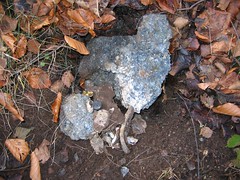
Thursday, 16 August 2018

North American F. Mk.4 Sabres (or are they Canadair CL-13s?) XD707 and XD730 :


Pat Cunningham (in the pic) offers the following information about the crash of two Sabres from No.66 Squadron, RAF Linton-on-Ouse, No. 12 Group, Fighter Command onto Kinder Scout and Black Ashop Moor on 22 July 1954 in which the formating pilots (Flying Officer James D. Horne, section leader (XD707) and Flight Lieutenant Alan Green, formating pilot (XD730)) were both killed.
When Russian-built swept-wing MiG-15 jet fighters were encountered in Korea in 1950, British manufacturers had nothing to match them. British transonic swept-wing fighters were under development to replace the straight-winged subsonic Meteors and Vampires, but until the Hunter arrived in 1955, Canadian-built Sabres filled the void. Held to be pleasant to fly, most of the Sabres were based in Germany, but No.66 Squadron was among those units equipped with them in Britain.

So it was that on 22 July 1954, four of the No.66 Squadron Sabres were recovering to Linton-on-Ouse, near York, after a high-level interception sortie flown in the course of a major annual-evaluation war-game. For the descent, the formation leader had split his section into pairs, each pair entering cloud independently at 12,000 feet.

Some time later, as his pair passed 5,000 feet, still in cloud, the overall leader transmitted an advisory warning to Flying Officer James Horne, now leading the second pair, against descending below 3,000 feet on their present heading: the more realistic safety height of the future was to be 3,800 feet. The foursome had noted already that Flying Officer Horne’s radio was weak at times, so he may not have heard the warning; certainly, he did not acknowledge.

Indeed nothing more was heard of him, or of his number two, until three days later when a walker came upon a body on The Edge, high above Black Ashop Moor. Until this discovery bad weather had hampered the search, although the keeper of the Kinder Reservoir had reported being alarmed by two jet fighters roaring at very low level towards cloud-covered Kinder. Despite his concern, however, he had heard no subsequent impact.

These aircraft had undoubtedly been the two Sabres, although what made Flying Officer Horne take his number two that low will never be known. A likely scenario, however, is that he saw a clearance below him, and dropped into what turned out to be a ‘sucker’s gap’ – a beckoning clearance which then closed in around him. Certainly, in his evidently hasty pull for a safe height, he managed to clear the edge of Kinder, but equally evidently something untoward happened after he had done so, for both aircraft struck the ground in a single impact point not many yards into the plateau.

To conjecture further, although Flight Lieutenant Alan Green, the number two, was more experienced than his leader, he was still settling in having been posted from another squadron. It could be then, that, caught out by the hastily initiated transition from level flight to very steep climb, he had – understandably – twitched just that little bit, causing his wingtip to lock with his leader’s tail. Or what is equally likely, bearing in mind that both aircraft were in very steep climbing attitudes, is that, in reaction to his leader’s over-hasty pull, Flight Lieutenant Green had pulled even harder, got high, and being momentarily unsighted from his leader, had collided in blindly pushing back into position.

The court of inquiry, however, did not treat with such speculation, finding only that Flying Officer Horne, as section leader, had failed to observe the area safety height – which he should have been familiar with regardless of any missed transmission – although it found some little mitigation in his faulty radio. It specifically noted that no blame was to be attached to Flight Lieutenant Green, whose sole responsibility had been to formate upon his leader.

Locations

SK 06926 89664 Kinder: initial impact point, start of debris trail (illustrated above)
SK 07268 90236 Black Ashop Moor: wings, gear, with an engine in an adjacent grough
SK 07300 90100 Black Ashop Moor, two debris pools
SK 07548 90390 Black Ashop Moor, the second engine

I note that there is a lot less here then in my last pic. Theft and vandalism by sad anoraks as usual.

The North American F-86 Sabre and its Canadair version, the CL 13

Pat Cunningham has offered a bit of a blurb about the Sabre, and its Canadair development the CL-13:

In the early 1950s the British-designed replacements for the by-then outclassed Meteor and Vampire fighters were suffering many developmental problems, so the appearance early in the Korean War (1950-53) of the Soviet MiGs quite discomfited the Royal Air Force planners. Accordingly, in fulfilment of a mutual defence agreement, Canada made over to the RAF 431 Sabre jets.

Fortuitously, the RAF was not a total stranger to the swept-wing type, a few of its pilots having flown with the Americans in Korea, in the process shooting down a number of MiG-15 jets. The first of the F-86 Sabre series flew in late 1947, but the version the RAF received was a 1950s development with, significantly, in terms of performance, an all-flying tail. Powered by an Allison J47-GE-13 engine developing 5,200 pounds of static thrust, it had a maximum speed of 679 mph (590 knots) at sea level, an initial climb rate of 7,250 feet a minute, and a laden weight of 17,806 pounds.

Most pilots found the Sabre a delight to fly and many expressed disappointment when it was replaced by the Supermarine Swift and by the early marks of the Hawker Hunter. Just the same, by mid-1956 Hunters had completely replaced the RAF’s Sabres, both in Germany and in the UK.

Tuesday, 14 August 2018

Short Stirling Mk.III LK502


Stirling:Lake Rudyard
Originally uploaded by seansonofbig2

Previously molten chunks of aluminium, scraps, and a marked negative terminal at the impact site of the Stirling bomber which crashed near Rudyard Lake. There are also many scraps around this location, and an adjacent patch of bare earth riddled with minutiae. Hard to believe it hasn't been kept bare by generations of souvenir hunters scratching around for bits.

Location:SJ 93949 59825

More info

Tuesday, 7 August 2018

North American F-86 Sabre F.Mk 4s XD707 + XD730: Kinder Scout Crash Site Vandalism

Jet Engine at Sabre Crash Site on Kinder Scout


I've had time to a bit of wreck hunting again. For anyone who doesn't know, this blog is the site that published accurate coordinates for the crash sites on Kinder Scout, amongst other places. We are going to be doing this again, now that I have rebooted the site.

We went to the Sabre wreck sites on Kinder Scout yesterday. The more exposed of the two jet engines has acquired a number of saw cuts since I last photographed it.

It looks like people wanted to take some bits home. All illegal of course. People died at this site.

Location:

SK 07348 90256

Friday, 24 April 2015

De Havilland Mosquito NF36 RL197 and Handley Page Halifax MkII DT578 Coded ZB? Great Whernside

Don't get many outings nowadays, but a comment on the post about Handley Page Halifax MkII DT578 by "MTSkull" implied that we had a couple of sites mixed up, and suggested a location for the impact site of the Halifax.

Me and Pat went and had a look, and here is what we found:

1. The site we thought might be the Halifax seems to be all Mosquito parts now, as evidenced by this stamp on one of the components. As any anorak knows, -98- is the prefix on all Mosquito components. Download and zoom in to see.


2. The site which we identified as De Havilland Mosquito NF36 RL197 has attracted the Halifax part which was some distance away at out our last visit. We know that this is a Halifax part because the stamp has a -57- prefix. Download and zoom in to see.


There were lots of unmarked bits of aircraft scattered all over the hillside around between these locations, which are themselves not far from the location of a Flying Fortress crash site. People clearly move the bits forming mixed wreckage pools.

We are happy that we have definitely found bits of all three 'planes. As far as the location of impact site is concerned, we looked fruitlessly  in the area indicated by our correspondent. That'll teach us to take advice from someone calling himself "empty skull"


Friday, 22 August 2014

Fairey Fulmar N4074


Matt ZX and Sean by the tiny remains of Fulmar N4074 on Minera Mountain. A grand day out with Pat Cunningham and Matt, wish we still had the time to go out most weeks, but too much work on.

Location: SJ 26358 51060
More Info:here

Tuesday, 5 November 2013

Bristol Blenheim Mk.V BA246


Bristol Blenheim Mk.V BA246


An outing with Mick and Moustache Steve to Bleasdale Fell in the Forest of Bowland Sunday before last yielded a couple of pools of wreckage from a fatal night training accident in 1944. This collection including undercarriage components is slightly lower than the main wreckage.


Tuesday, 24 September 2013

Lockheed P38-G Lightnings 42-12905 and 42-12928

A boggy day out last Sunday in Bowland with Pat and Mick - we found the crash sites of both of the Lightnings which collided in mid-air on a ferry flight and crashed on and near Dunsop Fell.

Lockheed P38-G Lightning 42-12905


Lockheed P38-G Lightning 42-12905
Location:SD 67407 54246
More info


Lockheed P38-G Lightning 42-12928


Lockheed P38-G Lightning 42-12928
Location:SD 66797 56393
More info

Photos c/o Pat Cunningham. We are back at work now, so no more outings for a while...

Saturday, 31 August 2013

North American P51 Mustang Mk.I AP208 and Boulton Paul Defiant Mk.I N1651 coded JT-Z

A grand day out with Pat and Mick yesterday yielded a twofer, a Mustang on Holdron Moss, and the Defiant on Hawthornthwaite Fell.

 North American P51 Mustang Mk.I AP208 wreckage on holdron moss, forest of bowland


North American P51 Mustang Mk.I AP208

Location: SD 60795 50779
More Info
Defiant Mk.I N1651 coded JT-Z on hawthornwaite fell, forest of bowland


Boulton Paul Defiant Mk.I N1651 coded JT-Z

Location: SD 57499 51584
More Info 

The "More info" links are to the relevant sections of Wotherspoon's book, which is now available free on Google books, in the unlikely event that you were thinking of buying it. His coordinates are very good for the Mustang. Less so for the Defiant.....  

Sunday, 14 April 2013

Consolidated B-24J Liberator 42-50668 Coded 6X M-

Consolidated B-24J Liberator 42-50668 Coded 6X M-, black hameldon


A rare day out for me and Mick yesterday took us to the Liberator crash site on Black Hameldon near Hebden Bridge, where these undercarriage components have survived the looters (see the "more info" link for details).

Location: SD 91182 30039

More Info